All posts by Logician

Teaching a Kid to Ride a Bike

My first memories of learning to ride a bicycle are not good. Oh my…

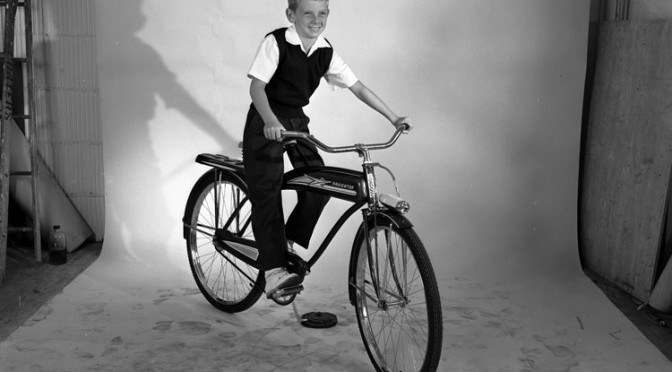
I remember precariously balancing on my new “Black Panther” bicycle at the top of a fairly gentle little hill in our yard. As I started to roll forward I hopped on the saddle with my legs splayed. My bike had pedal brakes only, and my feet were no where near them.

As I rolled down the hill, I was completely focused on trying not to fall over. I weaved and swerved as I gained speed, barely staying upright.

The bottom of the yard leveled out and ended in a bed of rose bushes. I was frozen on the bike and I tore into the rose bushes… and the thorns tore into me.

I still remember sitting in the bathtub, with scratches all over my body and it stinging like crazy.

It’s a wonder I ever got on a bike again.

When I taught my daughter to ride a few years ago, I was determined that she would not suffer the same fate. Here’s what I did… it worked great. She was quite a daredevil but never crashed once. She has since, but that’s

How to Teach a Kid to Ride a Bike Without Tears… or Backache

1. Buy a small bicycle with pedals that is suitable height for you child. With the saddle in the lowest position, they should be able to straddle and reach the ground comfortably. They should not just be able to touch the ground with their toes, make sure they can put their feet flat and there is a slight bend at the knee.

2. Remove the pedals from the bike. You don’t need them at this point, they just get in the way and can actually hurt our novice rider.

3. Hold the seat from behind and run behind them as they “walk” along with their feet. Here’s where a Bike Balance Training Handle comes in handy, as it allows you to have complete control over their bike without breaking your back!

It serves many other functions too. It let’s you slow them down if you’re on a downhill, they get away from you fast, which can be dangerous. This happened to me a couple of times, our road gradually gets steeper and steeper. Holding on to the seat is not safe under such conditions, you need something like the Bike Balance Training Handle so you have a secure grip. It let’s them steer and lean and get the feel of the bike, balancing, and how steering affects balance.

4. Once you are confident they can scoot and steer… let ’em rip! If it’s a safe area, flat, low traffic, you can take the training handle off. Let them experiment and scoot around by pushing themselves forward with their feet. (That’s why they need to reach the ground comfortably, so their legs have a little bend and they can push.) They will very quickly learn to balance and steer, and will naturally start lifting their feet so they glide further. Once they gliding for fairly lengthy distances, about 15 feet or more…

5. Put the pedals back on. Yup, they are ready. If you have a training handle that you’ve removed, you could put it back on just to be extra cautious and guide them as they make the transition to pedaling; but in my experience it is unnecessary.

If you want to make your life easier, and your child safer, I do recommend getting a Bike Balance Training Handle.

Good luck! Here’s to many years of happy riding together.
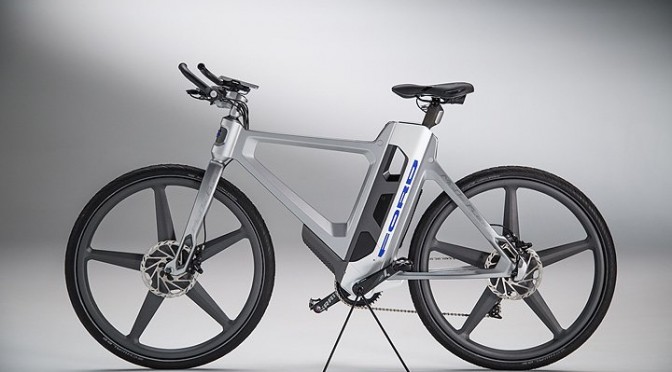
Ford’s MoDe Flex eBike

The electric bicycle business is a rapidly growing $30 million dollar sector, that shows no signs of slowing down.

Ford has announced a its first ebike, the MoDe Flex eBike, and it is pretty cool. It has few innovative safety and riding features that make it attractive for commuters.

Some of the highlights:

  • MoDe Flex folds down to a compact size for storage and putting it in the car
  • Bike can be recharged from your car outlet (or from an external source)
  • Connects to your smartphone and Ford app for routing, fitness data
  • App has a “No Sweat” mode which automatically signals the bike when to kick in electric power based on your heart rate data
  • The handlebars vibrate when you are about to be overtaken
  • It has brake lights

Ford’s MoDe Flex eBike

https://www.youtube.com/watch?v=pWe4fNr4Eqg

New From Garmin: The Word’s Smallest GPS Cycling Computers

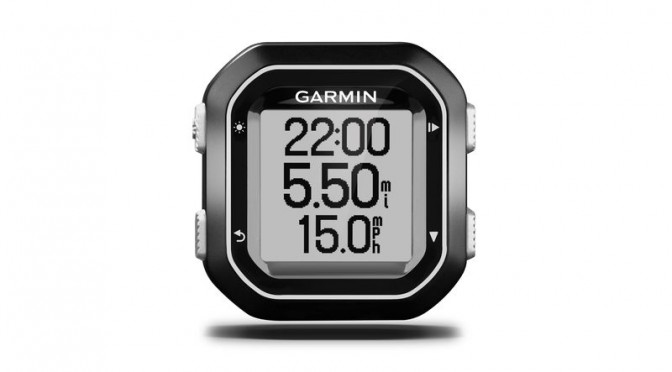
Garmin has just launched the Garmin Edge 20 and 25, the world’s smallest GPS-enabled cycling computers.

According to Garmin:

Edge 20 and 25 capture essential data, including time, distance, speed, total ascent and location. Connected features available on the Edge 25 also allow users to instantly share details of their rides with friends, family and on social media, and connect with a heart rate monitor, speed sensor1 and cadence sensor2 to get the most out of a ride.

Water-resistant3 and weighing only 25g, the Edge 20 and Edge 25’s extremely durable and small design is ideal for travel, training and everyday riding. Their interfaces make it easy to start, save and share activities and both are GPS and GLONASS-enabled, acquiring satellites quickly to track how far, fast and where a user is riding. Both devices feature up to eight hours of battery life. Additionally, the Edge 25 is ANT+ compatible and can be paired with a heart rate monitor, cadence sensor and speed sensor for additional data.

Garmin Edge 20 sells for $129.99

Garmin Edge 25 $169.99 and up

How the Backwards Bike Busts Your Brain

When I was in England last year, we stayed in a hotel that had a mirror in a corner of the room. When you looked at yourself in it, everything was reversed. No big deal right?

I stood my daughter in front of it, stood behind her and told her to block my slaps to her head. (I’ve taught her some Krav Maga/self defense.) With my right hand I slapped her right ear, but in the mirror in front of us it looked like my left hand was coming at her left ear. She instinctively raised her left hand to cover, but got slapped. Every time. We took turns and I did no better.

Occasionally we did block a blow but it was accidental, 95% of the time we got whacked on the head. It was frustrating but hilarious at the same time.

It demonstrated how automatized a lot of our behavior is… and how hard that can be to change.

Riding a bike is really hard at first, there’s the balancing, and the steering dynamic which changes how you need to balance and lean, then the pedaling on top of that.

It’s a bit like rubbing your stomach, patting your head, and reciting the alphabet backwards.

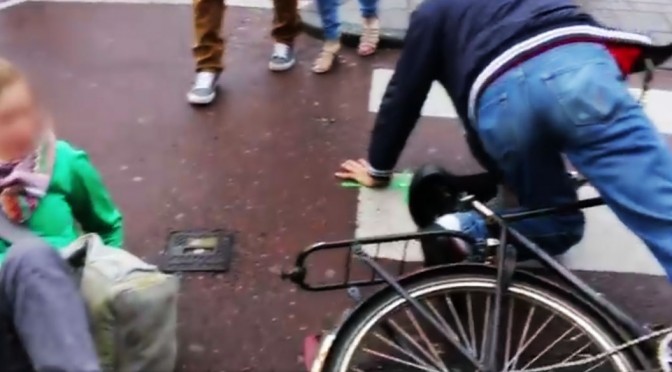
So what if, like in the double mirror case, you reversed one aspect of riding a bike. What would happen?

Here’s what…

Crash Culprit in Giro – What Was He Thinking?

The Giro is rolling, and after only 2 stages there’s drama.

Stage 1, the team time trial, gave some riders a kick in the butt and others a kick in the teeth.  Here’s how the top GC podium contenders fared:

Cycling Weekly: Winners and Losers of the Giro Stage 1

Drama in Stage 2 – Crash Caused By Spectator

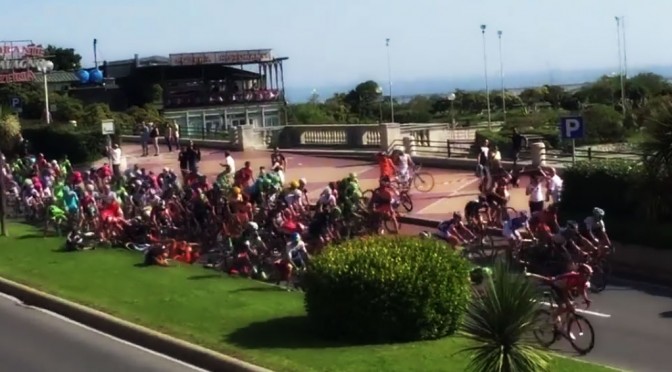
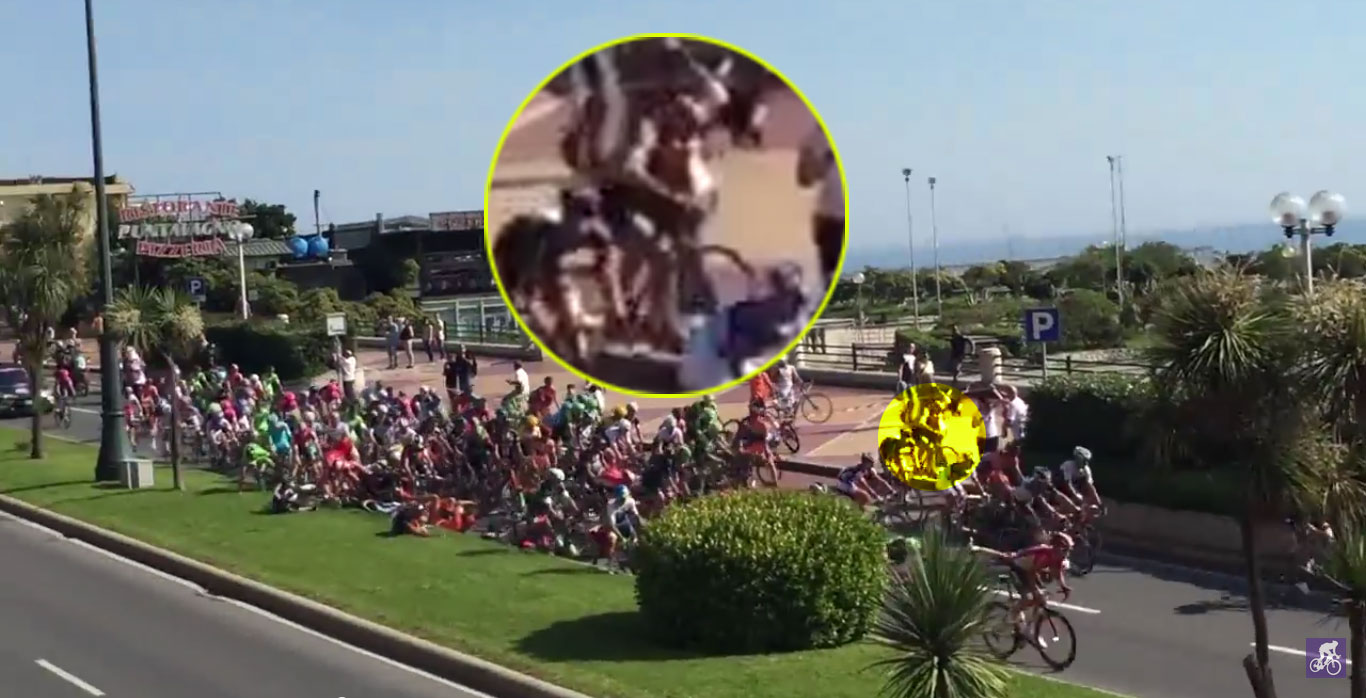
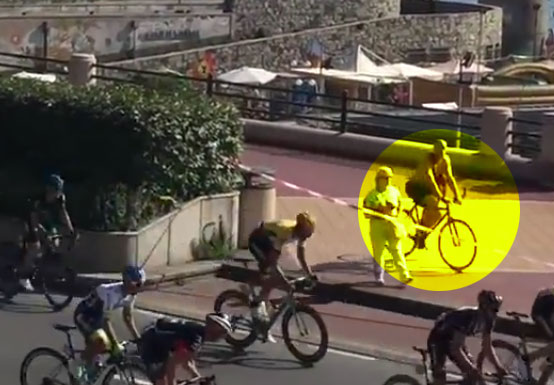
Giro Crash Stage 2In the final kilometers of stage 2 yesterday, a spectator on a bicycle, rode into the road and caused a 30-rider pile up. I snapped some stills from the point in a video where all hell broke loose…

Giro 2015 - stage 2 - crash culprity

Giro d'Italia Stage 2 CrashAnd then he nonchalantly rode back up onto the sidewalk and cruised on surveying the carnage he’d left behind.


Here’s the full video of the incident, see if you can spot the “crash dummy.”


Bombs and Bicycles – The “Skid Kids” of Postwar London

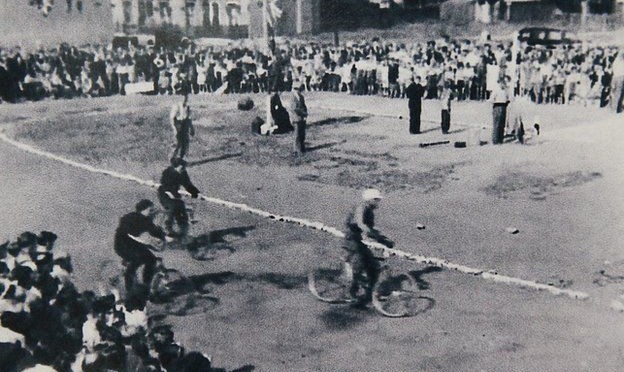
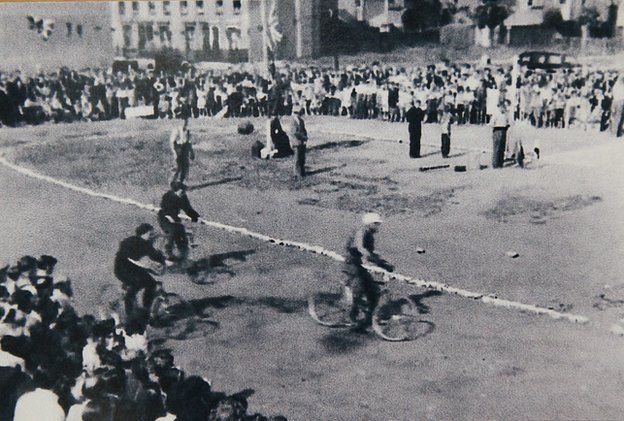
In the years after World War II and unlikely sport arose from the ashes of London’s bomb sites, cycle speedway.

skid-kids-east-surrey-grove-peckham-south-london-1948Kids from as young as 13 put London’s many bomb sites to productive use by turning them into speedway tracks and racing their bicycles around them.

Well I use the word “bicycles” but according to reports, most of these bicycles were not roadworthy, and many were homemade, sporting old wheels and frames, and bent gas piping for handlebars.

That did not stop the “skid kids,” who blasted around the dirt tracks dreaming of one day racing real speedway.

Cycle Speedway Boom in Postwar London

According to Wikipedia, the sport actually goes back to 1920s, but it really took off in London in 1945 with the abundance of bomb sites providing dirt tracks for the city’s daring youth.

Intercity tournaments commenced in 1946, and in 1950 the international clash between England and the Netherlands drew 10,000 spectators.

In it’s heyday in 1950, there were over 200 teams in East London alone. The total number of racers across the country is estimated at between 30,000 and100,000.

This emerging sport was a significant milestone in history, according to sports historian Simon Inglis:

“It was the birth of youth culture that hadn’t existed before, which enabled kids to have a completely separate identity to their parents for the first time – cycle speedway was something that no adult did.”

After 1950, the bomb sites were cleared and the sport declined rapidly, going back to it’s local roots at a few scattered tracks around the country, but essentially fading into obscurity.

BBC Magazine has an interesting article on the sport with comments from some of the original racers, one of whom at 84 is still racing his bicycle today (on the road).

Cycle Speedway is still going today in the UK, administered by British Cycling, and it is practiced in Europe and the United States.

Sources: Wikipedia, BBC Magazine