Don’t you hate it when your shifts start stuttering? You shift but the chain just won’t comply. It’s annoying! It sure doesn’t enhance the ride, and it doesn’t do your cassette or chain rings any good either!
As frustrating as they are, those little things are easy to fix when you know how.
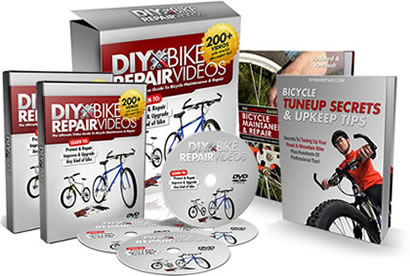
If you want step-by-step guidance on setting up your shifting perfectly, and other jobs, from big to small… and want to know how to keep your bike running silky smooth… there’s no better resource than pro bike mechanic Dave Delgado’s Easy Bike Repair Course.
Use it to save money… or to learn the trade
Whether you want to dip in now and then and fix annoying issues, perform major upgrades, or go through it systematically and learn the insider secrets and in-depth know-how to become a pro bike mechanic yourself, this thorough and in depth bike repair course has you covered.
Possibly the fastest way for anyone to learn bike repair. And you can do it all from the privacy of your home.”
– Bicycling Magazine
Stuck? Get free one-on-one support. For a limited time, Dave is offering one-on-one support with the course. He will answer your questions if you get stuck or need help in any way. It’s like being on a pro team with your own mechanic on call.
Never out of date. You pay once but get free access to all future updates to the course… for life.
No risk, money-back guarantee. If you’re not happy for any reason, Dave will insist on giving you your money back.
Save money while you learn the insiders tricks to keeping your bike singing like a pro’s bike… what’s not to like?
P.S. I don’t know about you, but I have tried repair books, and videos blow them away for this kind of instruction. Even Googling videos is hit and miss, you get the mumblers, the guy who rambles and takes 20 min to do a 2 min job… and then I wonder if he really knows what he’s doing. Maybe there’s a better way. With Dave’s professionally filmed course you get to fix, maintain and upgrade your bikes fast and save… and there’s no doubt that you’re doing it right.
However, the stability – that is, the ability to remain balanced – of a bicycle with a rider is more difficult to quantify and describe mathematically, especially since rider ability can vary widely. My colleagues and I brought expert and novice riders into the lab to investigate whether they use different balancing techniques.
The physics of staying upright on a bicycle
A big part of balancing a bicycle has to do with controlling the center of mass of the rider-bicycle system. The center of mass is the point at which all the mass (person plus bicycle) can be considered to be concentrated. During straight riding, the rider must always keep that center of mass over the wheels, or what’s called the base of support – an imaginary polygon that connects the two tire contacts with the ground.
Bicycle riders can use two main balancing strategies: steering and body movement relative to the bike. Steering is critical for maintaining balance and allows the bicycle to move to bring the base of support back under the center of mass. Imagine balancing a broomstick on one hand – steering a bicycle is equivalent to the hand motions required to keep the broomstick balanced. Steering input can be provided by the rider directly via handlebars (steering torque) or through the self-stability of the bicycle, which arises because the steer and roll of a bicycle are coupled; a bicycle leaned to its side (roll) will cause a change in its steer angle.
Body movements relative to the bicycle – like leaning left and right – have a smaller effect than steering, but allow a rider to make balance corrections by shifting the center of mass side to side relative to the bicycle and base of support.
Steering is absolutely necessary to balance a bicycle, whereas body movements are not; there is no specific combination of the two to ensure balance. The basic strategy to balance a bicycle, as noted by Karl von Drais (inventor of the Draisine), is to steer into the undesired fall.
Newbies versus pros
While riders have been described using mathematical equations, the equations are not yet useful for understanding the differences between riders of different ability levels or for predicting the stability of a given rider on a given bicycle.
Therefore, the goal of my colleagues’ and my recent work was to explore the types of control used by both novice and expert riders and to identify the differences between the two groups. In our study, expert riders identified themselves as skilled cyclists, went on regular training rides, belonged to a cycling club or team, competed several times per year, and had used rollers for training indoors. Novice riders knew how to ride a bicycle but did so only occasionally for recreation or transportation and did not identify themselves as experts.
We conducted our experiments in a motion capture laboratory, where the riders rode a typical mountain bike on rollers. Rollers constrain the bicycle in the fore-aft direction but allow free lateral (left-right) movement. They require a bicycle rider to maintain balance by pedaling, steering and leaning, as one would outdoors.
A subject preparing to ride the instrumented bicycle in our experimental setup.Stephen Cain, CC BY-ND
We mounted sensors and used a motion capture system to measure the motion of the bicycle (speed, steering angle and rate, roll angle and rate) and the steering torque used by the rider. A force platform underneath the rollers allowed us to calculate the lateral position of the center of mass relative to the base of support; that let us determine how a rider was leaning.
We found that both novice and expert riders exhibit similar balance performance at slow speeds. But at higher speeds, expert riders achieve superior balance performance by employing smaller but more effective body movements and less steering. Regardless of speed, expert riders use smaller and less varying steering inputs and less body movement variation.
We conclude that expert riders are able to use body movements more effectively than novice riders, which results in reducing the demand for both large corrective steering and body movements.
Mysteries remain
Despite our work and that of others in the field, there is still much to be learned about how humans ride and balance bicycles. Most research, including ours, has been limited to straight line riding, which only makes up a fraction of a typical bicycle ride.
Our work reveals measurable differences between riders of different skill levels. But their meaning is unclear. Are the differences linked to a higher risk of crashing for the novice riders? Or do the differences simply reflect a different style of control that gets fine-tuned through hours and hours of training rides?
Ideally, we would like to identify the measurements that quantify the balance performance, control strategy and fall risk of a rider in the real world.
With such measurements, we could identify riders at high risk of falling, explore the extent to which bicycle design can reduce fall risk and increase balance performance, and develop the mathematical equations that describe riders of different skill levels.
You might also like…
Easily Fix Annoying Problems and Make Your Bike Sing...
DIY Bike Repairs video course, you will save a bundle, and never be stumped by a bike repair again. This complete video course of bicycle repairs covers everything, from major upgrades to minor maintenance work. This professionally shot course is put together by pro bike mechanics, and is packed with insider’s tips and short cuts. The course comes with lifetime updates and a money-back guarantee, so there's no reason not to give it a try.
Spending a little time and money on keep your bike well maintained can save a ton of time and money down the road. Here’s some simple things you can do to minimize wear and keep your bike in tip top shape. Global Cycling Network has the scoop…
Whether you want to learn more about your bike, feel confident on the road, save money, or you're considering becoming a pro bike mechanic, this bicycle repair course has got you covered.
Taught by pro bike mechanics and packed with insider shortcuts and tips, it covers everything from minor repairs to the heavy stuff... and makes it easy to follow along, step-by-step, so you're never confused or wondering what to do next.
If you want to have an entire video encyclopedia of bicycle repairs at your fingertips, that covers you in every situation, then this package is worth a close look.
"Much easier to follow than a book, comprehensive, and loaded with insider tips and shortcuts... these DVDs belong on every cyclist's bookshelf." -Velo Logic
“People often say that motivation doesn’t last. Well, neither does bathing. That’s why we recommend it daily.” –Zig Ziglar
Lee Fancourt’s Land’s End-John O’Groats-Land’s End Attempt (LEJOGLE)
Lee Fancourt needs no additional motivation. If you remember he was trying to break the record for crossing the length of the UK and back (south-north-south). Unfortunately he had to call it quits on Thursday last week when he became ill and could not keep anything down. His attitude… hey it happens, I’ll be back next year.
BTW, his story is quite incredible. He’s a former boxer and runner but knee problems meant switching to the bike in 2011. He was told he’d never be able to ride long distances. Well he’s already done some incredible ultra endurance feats (including riding around the world). Learn more about him at LeeFancourt.com.
Vuelta Espana
Well the Vuelta started on Saturday and they’ve already hit the mountains! And there’s some controversy as Vincenzo Nibali (Astana) gets ejected for catching a tow with his team car following a crash. As you’ll see from the video below, it’s quite a tow. Why not just get in the car?
I say “course,” and it is that comprehensive, so if you’re a bike geek and want to do it from start to finish, you’ll know your bike inside out in just a few hours. You could even open your own bike repair business.
If that’s not you, you can just as well dive in at any point and pull up any video on any issue you’re having and learn how to fix it in minutes.
You save time, you save money, and you get it done right.
About that… I’ve had stuff screwed up by bike shops. You never know who’s going to be working on your bike, the seasoned pro, or the kid who works there afer school. I’m guessing the guy who cracked my carbon rim with a hairdryer trying to remove the tubular was not the head mechanic.
Short of going to in-person classes, this kind of video is by the best way to learn. Books are just too vague and confusing, like reading a story with every second page ripped out. For the life of me I cannot figure out what the hell happened between figure 1 and figure 2.
That’s not what this is. Sure, you do get a 150 page manual, a great quick reference and reminder, but the meat is the videos which show you step by step, and from multiple angles, with closeups.
Complete Bicycle Repair and Maintenance Course
What you do get is:
Expert instruction aimed at beginners and seasoned pros, taught by 3 experts, covering standard road bikes, racing bikes and mountain bikes.
200 videos (10 hours) plus 150 pages of in-depth lessons – it’s comprehensive, leaves nothing out, so you’re covered for almost any problem
Easy to follow step-by-step instructions
Detailed specifications, exploded views and photographs – so you’re never left wondering which part goes where, or what to do
Suitable for BOTH beginners and seasoned pros
Learn to fix, upgrade and maintain any bike, from road, race and mountain bikes – heck, you could open your own repair business if you like
From the simplest repair procedure to the most complex – this is not just the usual stuff like how to change a tube, or adjust a derailleur, want to upgrade any part of your bike… you’re covered.
Clearly see all procedures from multiple viewing angles, including up-close views – unlike static photos or one viewpoint videos, you get to see exactly what to do
The package is a steal, but Dave has thrown in a couple of bonuses that make it a no brainer:
You get all future updates and new videos, so your investment never goes out of date (…unlike the Park Tools Bicycle Maintenance Manual I have in my shed which cost me almost as much as this course).
Limited Bonus: You also get one-on-one coaching from Dave via Skype if you need clarification or advice.
BTW, you have 2 months to check it out, test it, and if for any reason you don’t think it’s a bargain, shoot him an email and you’ll get your money back, no questions asked.

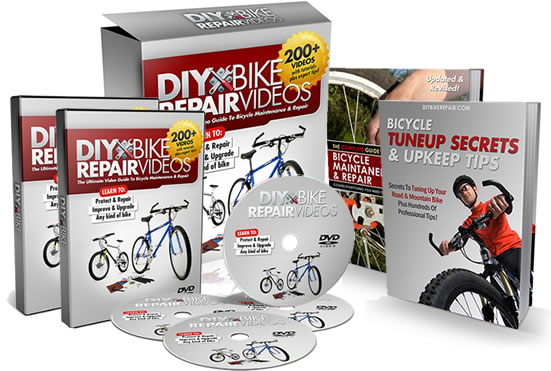
 If you want step-by-step guidance on setting up your shifting perfectly, and other jobs, from big to small… and want to know how to keep your bike running silky smooth… there’s no better resource than pro bike mechanic Dave Delgado’s Easy Bike Repair Course.