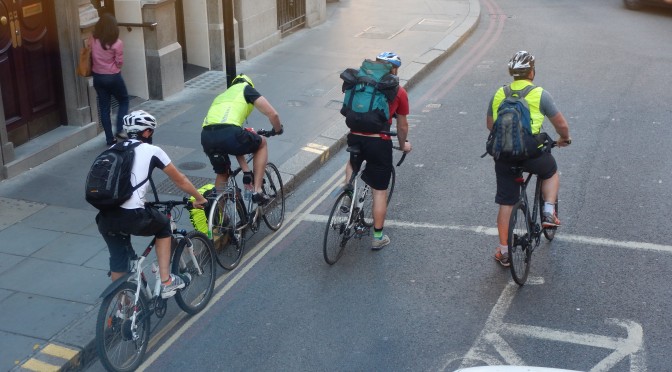
Chris Boardman and friends explain how to overtake a group of cyclists safely. While intended for a U.K. audience, it is just as applicable here in the U.S.
You might also like…

Chris Boardman and friends explain how to overtake a group of cyclists safely. While intended for a U.K. audience, it is just as applicable here in the U.S.
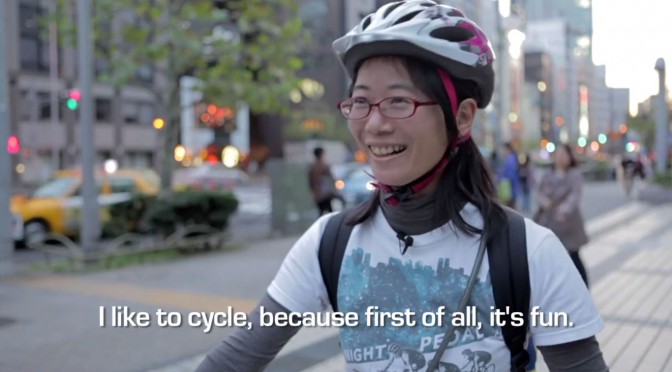
Cycling in Tokyo is a bit of a paradox. There’s only about 6 miles of cycling lanes in Tokyo, a tiny amount for a huge international city, yet many people ride their bikes in this densely populated city without a second thought. Why?
This StreetFilm video offers an explanation.
Catapult Future Cities has developed a prototype headset that gives cyclists a heads up display highlighting safe routes on the road as they ride.
Learn more about Catapult Future Cities
“I attribute this to my success. I never gave or took any excuse.” –Florence Nightingale
There has been a lot of discussion about whether the mandatory helmet laws are a good idea or not. Recently it resurfaced in the Australian Senate. (We’re talking traditional helmets here, not this kind.)
As I recall there are at least three main issues: 1) the effectiveness of helmets, 2) whether they help or hinder safety on the road, 3) whether helmet laws deter cycling in general.
On the effectiveness of helmets, I’ve had at least two concussions… er, that I can remember. The most serious one, referred to as “the alleged accident” at Velo Logic HQ, where I was unconscious and hospitalized, happened taking a gentle corner at 16-18 mph (according to a friend behind me).
Ever since then I’ve had doubts about the efficacy of helmet, though I still wear one. (On helmet ineffectiveness see Robinson Dorothy, 2006. Do enforced bicycle helmet laws improve public health?. BMJ 2006;332:722-725.)
Regarding helmets effect on the road, research has shown that drivers give cyclists without helmets significantly more room when passing. (Ian Walker found that wearing a helmet led to a 23% increase in cars inside the 3 ft danger zone, Accident Analysis & Prevention, March 2007.)
In my opinion the issue is easily resolved. As the Aussies say, it’s bloody simple mate, leave it up to the cyclists, let each person decide whether to wear a helmet or not. We’re big boys and girls, we can make up our own minds and accept the consequences.
This is not a trivial issue, which is precisely why people should be able to decide for themselves, not forced to conform to what politicians and bureaucrats decide is best.
What say ye?
Australian Senate Inquiry Hears from Doctors and Academics
In Helsinki a group of 850 cyclists riding in honor of a cyclist killed in a collision with a car last week, were inadvertently part of a demonstration of just how dangerous cycling can be, when a bus ran into the group. Thankfully no one was seriously injured, but fisticuffs ensued between a cyclist and the bus driver.
Bus Collides with Cycling Safety Demonstrators
—–
Let’s make it a great week, no excuses.
Helmet technology has been pretty static for decades, but lately it’s been hotting up. I can think of a few helmets in the last couple of years, from the moderately innovative, to the radical “Invisible” helmet.
Now there’s a new shell for your nut, waiting in the wings. The Bling Helmet claims to be “smart” and brings new powers to the lowly and previously dumb helmet, including lights, music, phone calls, walkie-talkie and SOS messaging. Phew.
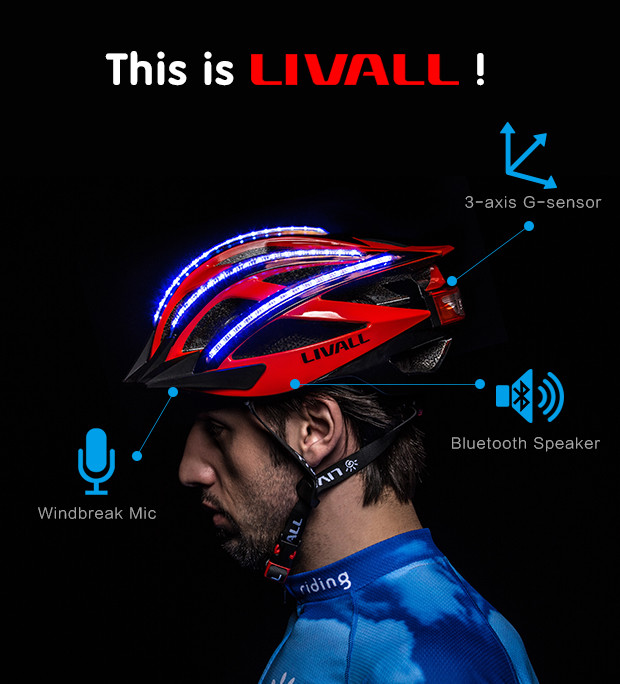
The helmet comes with the Bling Jet, a remote control for your helmet. It allows you to control your helmet’s lights and control your phone, so you can answer calls, play music, and even shoot video of your ride.
The SOS Alert is triggered when the helmet detects a crash or fall, it automatically messages your emergency contacts.
Can’t you just see your buddies slapping you around your head trying to trigger the SOS message? Or is that just my idea of fun?
The Bling with the Jet remote control will retail for around $238.
The Bling Helmet is marketed as “the first smart and safe helmet.” Hmm… how safe is it to use that technology while riding?
IMO the big danger with phones is not the device and whether it’s hands-free or not, it’s the divided attention. You can’t have your full attention on the road, be fully aware of what’s happening around you, and be anticipating dangers and “what-ifs,” if you’re having a conversation with someone.
How about fiddling about on the handlebar remote trying to find that song?
Ain’t smart. Ain’t safe. Not saying you shouldn’t do it. I’ve done it in certain circumstances. But let’s have no illusions as to the dangers involved. And having our helmets call our friends to tell them we’re dead, but hey we went out rocking, isn’t much consolation.
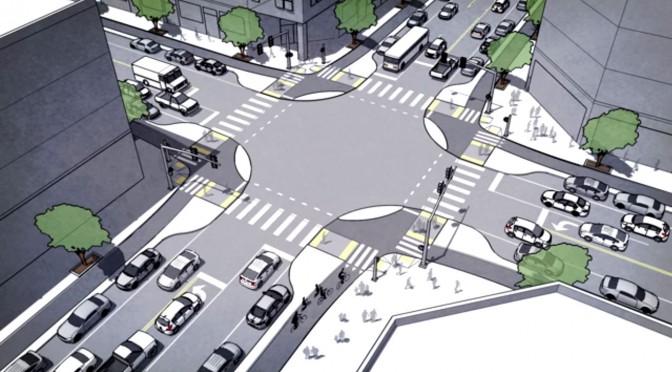
Here’s an interesting and well presented idea from from Nick Falbo, on making intersections safer for cyclists.
Learn more at ProtectedIntersection.com
I used to ride at night a lot! Twice a week I’d do the local hammerfest and then ride solo for another 3 hrs. I loved riding at night, it was cooler, quieter, and so I thought… much safer.
After all, I could see the cars coming a mile away thanks to their lights, and they could see me as I had bright front and rear lights. And I rode for years without incident.
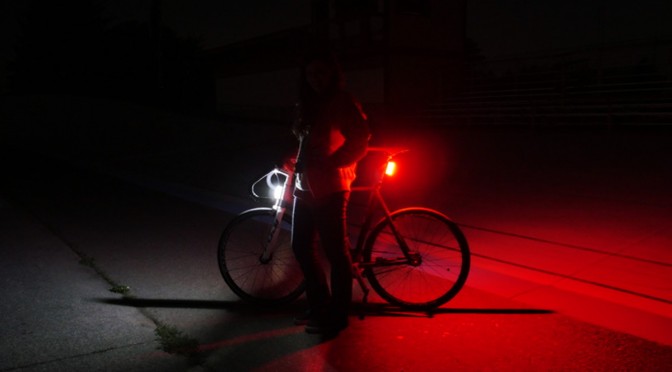
One night that naive assumption was shattered when I had a very close call. The road snaked in such a way that my light was not visible until too late. and I came close to being whacked. I wonder if I would have been much more visible had I had something like the Orfos Flares bike light. I think so.
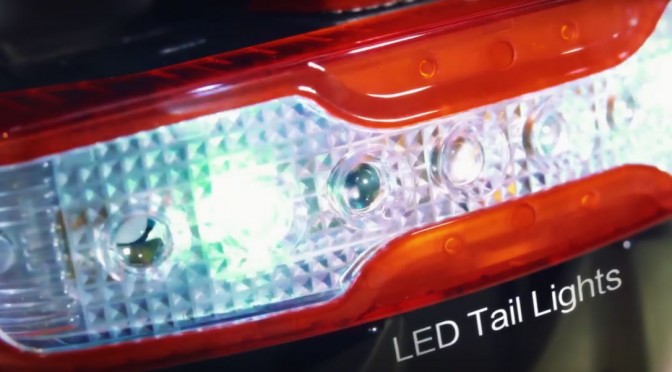
The Orfos Flare is an LED light that emits a glow in 360 degrees, rather than a directional beam like a traditional bike light does. The case surrounding the LED diffuses the light.
What this means is that (part of) the rider and the surrounding environment is lit, making the rider more visible.
The lights are also completely waterproof… just in case you encounter a deluge of Biblical proportions.
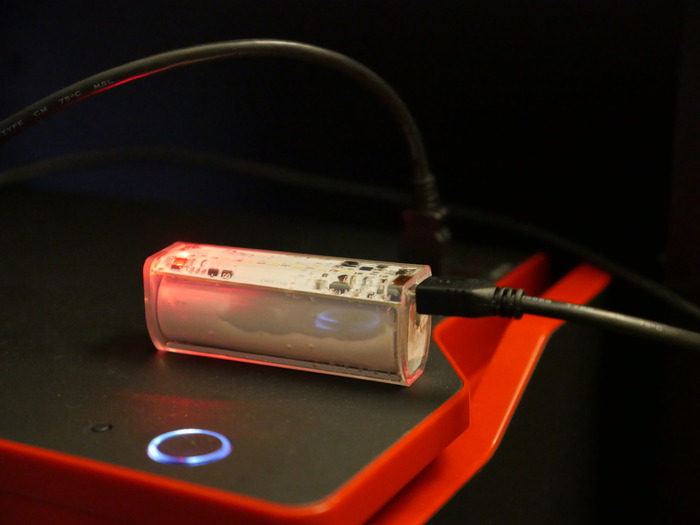
A cool feature is that the lights attach to the bike magnetically. There is a mount that you attach to your bike with cable ties, and then the light magnetically sticks to the mounting, so you can quickly attach and remove the lights as needed.
The lights run on a rechargeable battery, and are charged via a micro USB port. Apparently, you can get 24 hrs of light from a 90 min charge. Not bad.
The inventor is Pete Clyde, an electrical engineer, and he plans to have the lights shipping by Christmas.
The Monkey Light will do something similar, it’s available right now – check it out: The Monkey Light – cycling safety light
Learn more about the Orfos Flare Light or check it out on Kickstarter.