Here are the highlights of each stage of the 2016 Tour de France, courtesy of GoPro.
Stage 5 Highlights
Stage 4 Highlights
Stage 3 Highlights
Stage 2 Highlights
Stage 1 Highlights
You might also like…


Here are the highlights of each stage of the 2016 Tour de France, courtesy of GoPro.
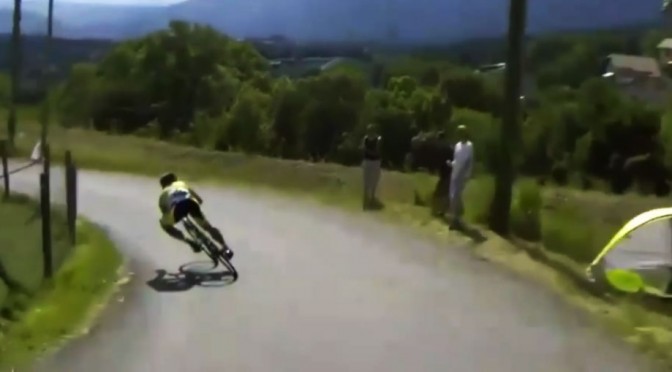
Peter Sagan displays magnificent descending skills as he chases Ruben Plaza down the Col de Manse during Stage 16 of the 2015 Tour de France.
https://www.youtube.com/watch?v=UHgeNu5Gq-c
Sagan was unable to catch Plaza but took second, his fifth of this year’s Tour.
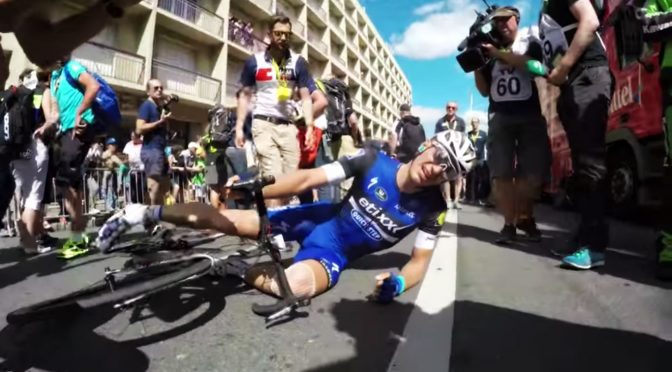
The early days of the Tour are notorious for crashes, but yesterday during stage 3 things got bad, the stage had to be neutralized while medics took care of riders.
https://www.youtube.com/watch?v=mSULhAyY9QQ
According to Cycling Weekly:
“The double crashes on a fast descent in the Ardennes at the Tour de France on stage 3 left many of the riders battered, scraped and bruised on the worst possible day – right before they hit the cobbles of Northern France. So numerous were the injured that race organisers were forced to halt the stage to let the medics do their jobs.”
Cycling Weekly Photo Gallery of the Crash
Cancellara who was in yellow went down and has abandoned with a fractured vertebrae. Many other riders were injured. Those who survived have to face the cobbles today.
“Get a bicycle. You will not regret it if you live.” -Mark Twain
Here’s a quick overview of where the Tour de France will be passing this year. The Tour kicks off July 4th in Utrecht and ends July 26 in Paris.
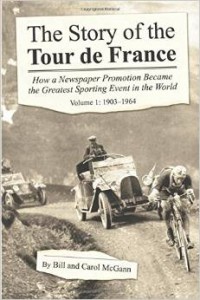 The Story of the Tour de France is a rare gem of a book in a crowded category. It grabs you from the start, electrifies and keeps you immersed in the powerful drama that is the Tour.
“Drenched in rich detail.” -Paul S
“As soon as I began reading this book I was hooked!” -John W
The Story of the Tour de France
| Stage | Date | Course | Distance | Type of Stage | |
| 1 | 4 July | Utrecht – Utrecht | 13.8 km (9 mi) | Individual time trial | |
| 2 | 5 July | Utrecht – Neeltje Jans | 166 km (103 mi) | Flat stage | |
| 3 | 6 July | Antwerp – Huy | 159.5 km (99 mi) | Medium-mountain stage | |
| 4 | 7 July | Seraing – Cambrai | 223.5 km (139 mi) | Flat stage with cobblestones | |
| 5 | 8 July | Arras – Amiens | 189.5 km (118 mi) | Flat stage | |
| 6 | 9 July | Abbeville – Le Havre | 191.5 km (119 mi) | Flat stage | |
| 7 | 10 July | Livarot – Fougères | 190.5 km (118 mi) | Flat stage | |
| 8 | 11 July | Rennes – Mûr-de-Bretagne | 181.5 km (113 mi) | Medium-mountain stage | |
| 9 | 12 July | Vannes – Plumelec | 28 km (17 mi) | Team time trial | |
| 13 July | Rest Day | ||||
| 10 | 14 July | Tarbes – La Pierre Saint Martin | 167 km (104 mi) | Mountain stage | |
| 11 | 15 July | Pau – Cauterets | 188 km (117 mi) | Mountain stage | |
| 12 | 16 July | Lannemezan – Plateau de Beille | 195 km (121 mi) | Mountain stage | |
| 13 | 17 July | Muret – Rodez | 198.5 km (123 mi) | Medium-mountain stage | |
| 14 | 18 July | Rodez – Mende | 178.5 km (111 mi) | Medium-mountain stage | |
| 15 | 19 July | Mende – Valence | 183 km (114 mi) | Hilly stage | |
| 16 | 20 July | Bourg-de-Péage – Gap | 201 km (125 mi) | Medium-mountain stage | |
| 21 July | Rest Day | ||||
| 17 | 22 July | Digne-les-Bains – Pra Loup | 161 km (100 mi) | Mountain stage | |
| 18 | 23 July | Gap – Saint-Jean-de-Maurienne | 186.5 km (116 mi) | Mountain stage | |
| 19 | 24 July | Saint-Jean-de-Maurienne – La Toussuire – Les Sybelles | 138 km (86 mi) | Mountain stage | |
| 20 | 25 July | Modane – Alpe d’Huez | 110.5 km (69 mi) | Mountain stage | |
| 21 | 26 July | Sèvres – Paris | 109.5 km (68 mi) | Flat stage | |
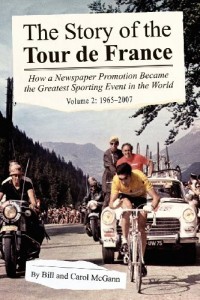 The Story of the Tour de France Volume 2 covers the period from 1965 to 2007, with even more drama and excitement.
“Volume 2 is even better; more robust and with greater detail; and it is the best piece on the world’s greatest sporting event ever.” – Paul S
The Story of the Tour de France Volume 2
France and the West is under assault from terrorist groups around the world. Now one Tour de France team wants to honor a terrorist during the Tour.
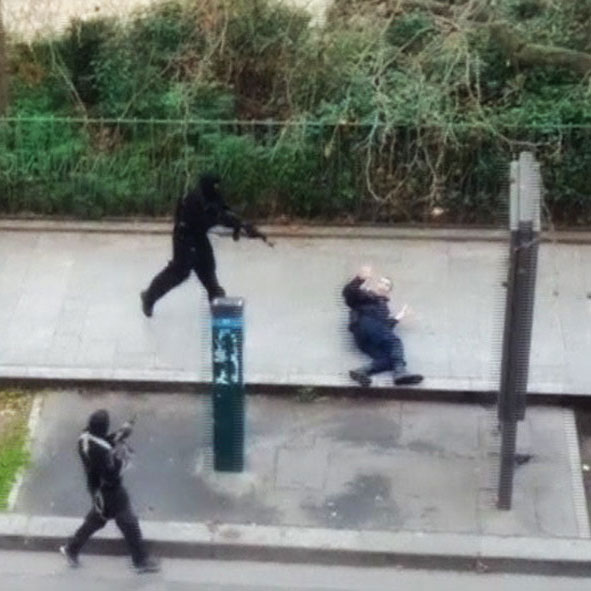 On January 7, 2015, France and the rest of the civilized world, was rocked by a barbaric act of terrorism in the epicenter of civilization, Paris, France. Two Islamist terrorists entered the offices of a weekly newspaper and slaughtered 11 people, and wounded another 11.
The carnage did not end there. In the days that followed there were further hostage takings, murders and injuries.
Exactly one week later, on January 14, the Tour de France organizers announced the teams in the 2015 Tour de France. Included in the roster is the first African-registered team, MTN-Qhubeka.
What has this got to do with the terrorist atrocities a week earlier?
The MTN-Qhubeka team is planning on turning July 18 in to a day of celebration of a political icon. That’s bad enough, but the political icon they’d like to honor was not just any political icon, he was an advocate of terrorism.
The team, along with the Mandela Foundation, would like to celebrate Nelson Mandela.
What most people do not know is that Nelson Mandela’s ANC group was a terrorist organization. The ANC’s goal was to impose Soviet-style communism on South Africa.
In 1961 Mandela co-founded the so-called “military” wing of the ANC, Umkhonto we Sizwe (“Spear of the Nation”).
In 1964, Mandela was convicted on 193 counts of sabotage and smuggling of munitions, including 210,000 soviet hand grenades and other bomb-making materials.
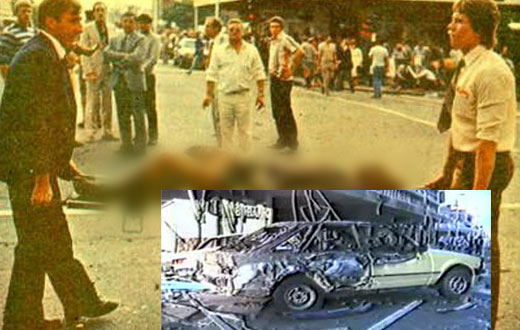
The ANC and Mandela’s “Spear of the Nation” went on to assassinate political enemies, bomb banks, shopping centers, restaurants, and indiscriminately slaughter blacks, whites, men, women and children.
All in all the Global Terrorism Database lists 606 acts of terrorism committed by the ANC.
This wasn’t limited to attacks against military, police and government targets, or even whites. The ANC used violence and terror extensively among the black population to command obedience and loyalty to the ANC, and to exterminate and instill fear in their political opponents.
As despicable as the apartheid regime was, Mandela was not in prison for his ideas or opposition to apartheid, it was because of his acts of violence and advocacy of terrorism. (Many people were opposed to apartheid and were not in prison.)
In fact, in 1985 then Prime Minister P.W. Botha offered Mandela his freedom in exchange for simply renouncing violence. He refused.
In 1986, as if to reaffirm the ANC’s commitment to terrorism, Nelson Mandela’s wife, Winnie Mandela, said, “With our boxes of matches and necklaces we’ll liberate this country.”
She was endorsing the horrific practice of “necklacing,” putting a tire doused in gasoline over someone’s neck, and setting them on fire.
The victim suffered a slow and agonizing death. Eyewitnesses report that it could take up to 20 minutes for the victim to die. Over a thousand people are estimated to have been tortured and killed by necklacing.
In order to defeat the bloody scourge of terrorism, we have to tackle it head on philosophically and militarily. We have to clearly identify it, condemn it, and deprive it of every shred of respectability.
There can be no ambiguity, no appeasement, and certainly no honoring of its advocates and perpetrators.
At a critical time when the West is under a bloody and barbaric assault from Islamic terrorists, at a time when the Parisian atrocity is fresh in our minds; how appropriate is it to turn the Tour de France into a vehicle for celebrating a man who had more in common with those who perpetrated the Paris massacre than with its victims?